

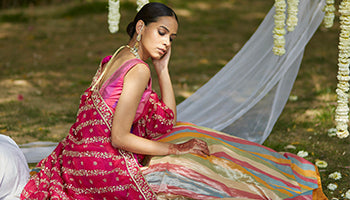

There is a certain kind of woman who has never needed to choose between where she comes from and where she is going. She moves through both worlds as if they were always one. OhFab was made for her.

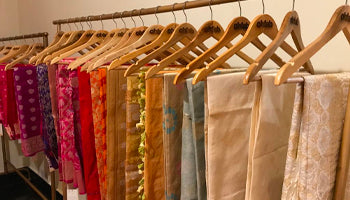
Our design language begins with the textile - handwoven Tanchoi brocades, Pachranga and Satranga checks and stripes in silk and organza and builds outward from there.
The designs move between the grandeur of India's finest monuments and the ease of an evening on the Riviera. Never heavy.
Always occasion-ready, for the moments that stay with you.

THE FOUNDERS
Aanchal and Akshita didn't set out to build a brand. They set out to hold on to something: the memory of their mothers in the finest Indian textiles, dressed for occasions that deserved that kind of care. They grew up in a house in Ambala, in Northern India, that was never just a house, where the door was always open and everything in it had a story, and where their father's eye for what would last found its truest expression in what he chose for their mother to wear: saris kept for decades, zardozi mended rather than replaced, nothing beautiful ever thrown away.
"We never replaced things just because something newer had come along," Aanchal recalls. "The original was always better. You just had to know how to look." They learned to look, at the tanchoi on their mother's wedding sari, at their great-grandmother's Banarasi, still kept, still held close, one eye and one instinct passed down through what a family chooses to hold on to.
The sisters studied in the UK and France, and it was there, at a distance, that the lesson their parents had taught them without ever naming it came into focus: that a beautiful thing, made well, is not an indulgence; it is a kind of continuity. Living between London and Paris gave them a global eye, but it kept turning back toward home. That feeling stayed with them wherever they went, and OhFab is where it came home, built on the conviction that India's most beautiful handloom traditions deserve to be worn and lived in, not admired from a distance.
It is a love letter to everything they grew up watching, seen clearly only once they'd left, and never wanted to lose.